

- December 18, 2025
- Posted by: Vesna Latic
- Categories: Home slider, RAI News
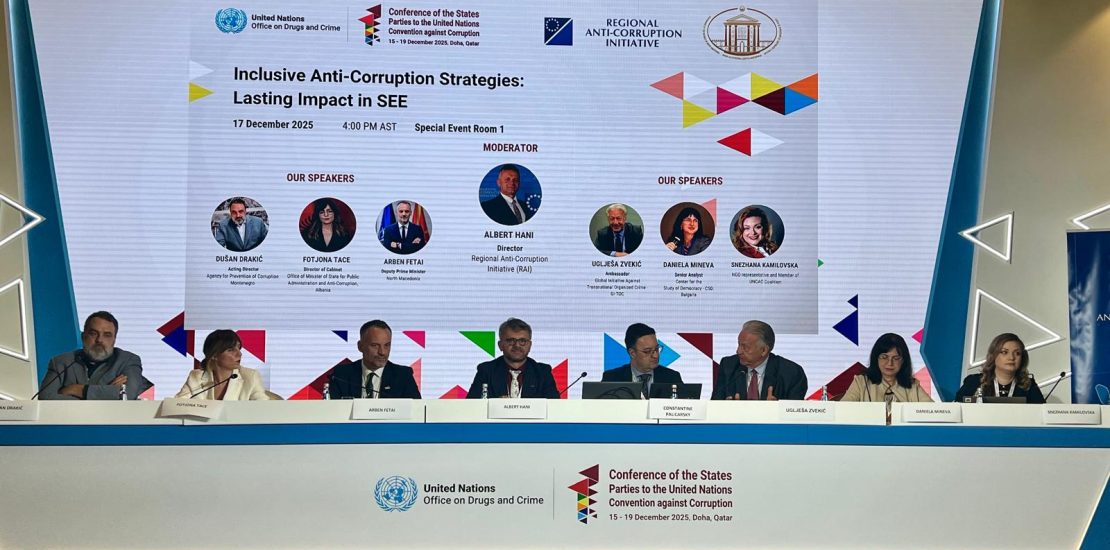
Doha, 17 December 2025 – On the day dedicated to national anti-corruption strategies at the 11th Conference of the States Parties to the UN Convention against Corruption (CoSP11), Southeast Europe took the floor. Jointly organized by the Regional Anti-corruption Initiative (RAI) and the Government of the Republic of North Macedonia, the special session “Inclusive Anti-Corruption Strategies: Lasting Impact in Southeast Europe” showcased how the region is translating political commitments into sustainable reforms and measurable results, presenting evidence-based tools, best practices, and anti-corruption solutions developed in the region and by the region.
Moderated by Albert Hani, Director of RAI, and Constantine Palicarsky, Crime Prevention and Criminal Justice Officer at UNODC, the session examined how inclusive and evidence-based anti-corruption strategies deliver practical outcomes and lasting institutional impact. Speakers shared concrete examples, lessons learned, and recommendations for strengthening regional cooperation, bringing forward the voices of those who turn political commitments into real change.
Arben Fetai, Deputy Prime Minister in charge of Good Governance of North Macedonia, underlined the decisive role of political leadership in moving from strategy to implementation, emphasizing strong political will and the systematic inclusion of civil society, think tanks, and academia as watchdogs and partners. From Albania, Fotjona Drace, Director of Cabinet at the Office of the Minister of State for Public Administration and Anti-Corruption, highlighted digitalization, integrity frameworks, EU integration-driven reforms, and close cooperation with partners such as RAI as key enablers of measurable anti-corruption results.
Dušan Drakić, Acting Director of Montenegro’s Agency for Prevention of Corruption, stressed the importance of independent institutions with sufficient powers and resources, pointing to the Treaty on Exchange of Data for Verification of Asset Declarations as a concrete regional tool that is now delivering results following its entry into force. Ambassador Uglješa Zvekić of the Global Initiative against Transnational Organized Crime emphasized strategic leverage points for strengthening integrity within criminal justice systems, while Daniela Mineva of the Center for the Study of Democracy presented practical methodologies developed under EU-funded projects implemented in partnership with RAI, supporting countries in measuring progress and addressing state capture and strategic corruption. Representing civil society, Snezhana Kamilovska, a member of the UNCAC Coalition, stressed that civil society has the greatest impact when it is included from the very beginning of the anti-corruption process and meaningfully involved in both drafting and implementation.
Despite diverse national contexts and multi-stakeholder perspectives, three common conclusions emerged from the discussion: the central role of independent anti-corruption bodies with adequate powers and resources; the importance of effective tools for transparency, integrity, and digitalization developed through a multi-stakeholder approach; and the indispensable role of political will and effective law enforcement, without which even the best strategies cannot succeed.
At CoSP11, Southeast Europe demonstrated that regional cooperation delivers results. By presenting concrete tools, practices, and solutions developed collectively, the session reaffirmed RAI’s role as a platform for cooperation, knowledge-sharing, and support to countries, particularly on their EU accession paths and sent a clear message from Doha: inclusive, evidence-based strategies lead to lasting anti-corruption impact.